
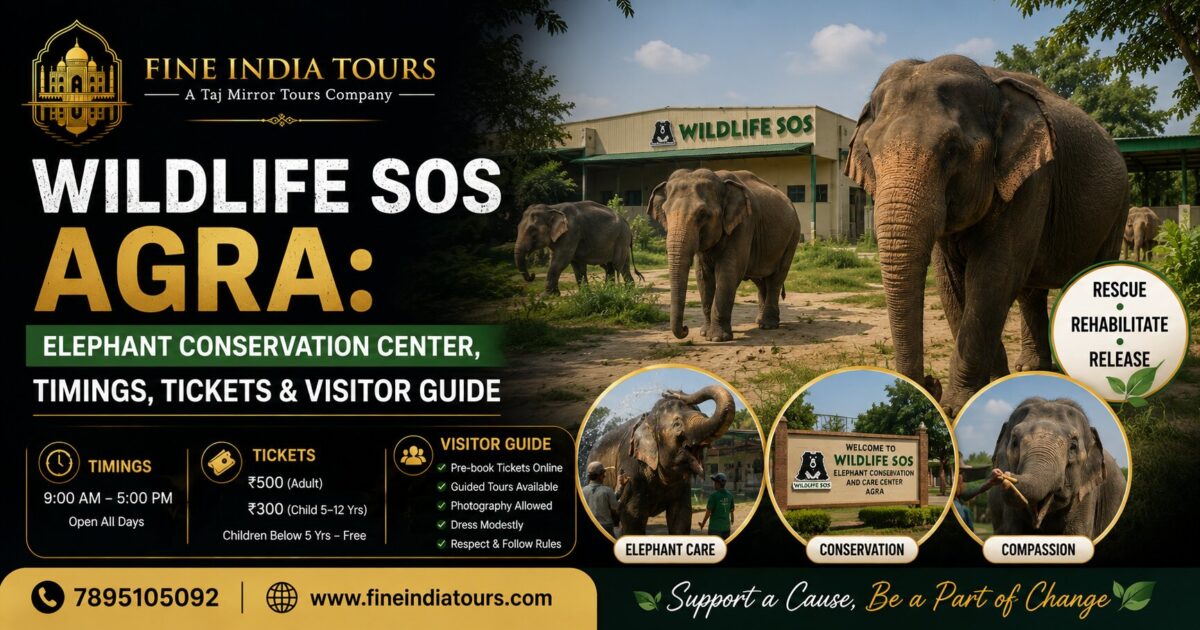
If you wish to enjoy some wildlife fun in Agra apart from visiting the Taj Mahal and other historical places, then you should definitely visit Wildlife SOS Agra Area and get yourself some wildlife rescue, rehabilitation and education experience. Rather than being just another tourist place, this wildlife experience gives you something very significant to see and experience.
One thing to remember before going there is that the Elephant Conservation and Care Centre (ECCC) which forms a part of Wildlife SOS organization is actually in Mathura District, Uttar Pradesh, en route to Agra-Mathura. The information about the place provided by Wildlife SOS says that it is a specialized centre located at Ghari Churmura, Farah, close to Sachdeva Institute of Technology, and established in 2010 in partnership with Uttar Pradesh Forest Department.
If you are interested in arranging a trip to the Taj Mahal and Wildlife SOS, then Fine India Tours is a nice agency which can make it all possible for you. This company even provides one of their itineraries with a name Taj Mahal at Sunrise & Wildlife SOS (Elephant & Bear Visit).
Why Add Wildlife SOS to Your Agra Trip?
A normal Agra sightseeing itinerary is usually built around Mughal architecture. The Taj Mahal, Agra Fort, Mehtab Bagh, and other heritage sites tell the story of the city’s royal past. A wildlife conservation visit offers a completely different experience.
The purpose here is not simply to “see elephants.” The centre is designed around the rescue, rehabilitation, care, and conservation education of elephants that have experienced severe abuse or exploitation. Wildlife SOS says the elephants under its care were rescued from difficult circumstances, including begging, temple captivity, and circus-related exploitation.
That makes the experience especially suitable if your travel preferences include:
- Ethical wildlife tourism
- Family-friendly educational experiences
- Private Agra tours
- Wildlife and conservation experiences
- Meaningful activities beyond traditional sightseeing
- Responsible travel in India
For international visitors, it can also provide useful context about India’s approach to wildlife rescue and animal welfare.
Elephant Conservation and Care Centre: What You Are Actually Visiting
The centre is more accurately described as an elephant rescue and rehabilitation facility rather than a zoo. Its purpose is to provide rescued elephants with space, food, veterinary attention, enrichment, and long-term care.
According to Wildlife SOS, the facility was established in 2010 and now provides a protected environment for rescued elephants. The centre has open areas, vegetation, walking spaces, trees, and water pools where elephants can bathe and play. The organization also states that the facility is bordered by the Yamuna and surrounded by forested land.
This distinction matters when planning your visit. You are not booking an attraction where animals are displayed for entertainment. Instead, the experience is built around conservation education and responsible observation.
That is also why Wildlife SOS does not promote casual direct interaction with elephants. Its visitor FAQ states that direct contact is not part of volunteering because the organization is committed to ethical animal treatment; trained keepers are responsible for interacting with the elephants.
Wildlife SOS Agra Timings and Visit Planning
One of the most important things to understand is that the centre should be visited through its official visitor or conservation education arrangements, rather than treated like a monument where you simply walk up and purchase a standard entry ticket.
Wildlife SOS currently promotes conservation education tours at its rescue centres and asks prospective visitors to contact its programme team for arrangements.
Because visitor schedules and availability can change, it is better to confirm the exact slot before travelling. This is particularly important if you are building your visit around a Taj Mahal sunrise tour or a same-day Delhi–Agra itinerary.
For a smoother experience:
- Confirm your visitor slot in advance.
- Check the latest instructions directly with Wildlife SOS.
- Allow sufficient road-travel time.
- Avoid building a tightly packed itinerary around the visit.
- Ask your tour planner to coordinate transfers between attractions.
This approach is much safer than relying on old blog posts that may contain outdated opening hours or ticket information.
Wildlife SOS Tickets and Booking
Searching online for a fixed Wildlife SOS Agra ticket price can be confusing because visitor experiences, conservation education visits, and volunteering programmes are not necessarily the same product.
The official Wildlife SOS information confirms that the centres welcome visitors for conservation education and asks visitors to contact the organization to make arrangements.
Therefore, rather than quoting an unverified ticket amount, check the current official booking information before making payment. This is particularly important because prices, visitor categories, availability, and programme formats can change.
If you are booking through a professional travel company, ask specifically what your package includes. A private tour may include:
- Hotel pickup and drop-off
- Private air-conditioned vehicle
- Driver assistance
- Wildlife SOS visit coordination
- Taj Mahal sightseeing
- Agra Fort visit
- Customized meal or break arrangements
Fine India Tours offers customized Agra experiences and specifically lists a combined Taj Mahal and Wildlife SOS itinerary, which can be useful for travelers who want the logistics handled professionally.
What Can You Expect During the Visit?
The experience is designed to help visitors understand the lives of rescued elephants rather than simply watch them from a distance.
Depending on the programme and the day’s activities, visitors may learn about elephant rescue, rehabilitation, nutrition, enrichment, veterinary care, and the challenges faced by captive elephants.
Wildlife SOS explains that rescued elephants receive nutritious food, regular veterinary care, opportunities for bathing, and space to walk and explore.
One of the most interesting aspects is seeing how rehabilitation goes beyond physical recovery. Many rescued elephants arrive after years of difficult living conditions. Their long-term care therefore requires attention to their physical condition as well as their behaviour and daily routine.
For families travelling with children, this can turn a sightseeing day into an educational experience. Children can learn why wildlife should be observed responsibly and why elephant rides and other exploitative activities should not be treated as harmless entertainment.
The Elephant Hospital Experience
Another reason this conservation visit stands out is the veterinary work associated with the centre.
Wildlife SOS established an elephant hospital at the Mathura facility to provide specialized treatment for injured, sick, and geriatric elephants. The hospital includes diagnostic and treatment facilities, equipment such as portable X-ray and ultrasound systems, and areas designed for veterinary care and observation.
This medical component adds considerable depth to the visitor experience. Instead of seeing only the visible side of animal rescue, travelers can understand the professional care required after an elephant has been rescued.
For responsible tourists, that makes the experience more valuable than a typical wildlife attraction. You get an opportunity to see how wildlife rehabilitation, veterinary science, and conservation education work together.
Best Way to Visit from Agra
If you are staying in Agra, the most convenient option is usually a private car with a planned itinerary. The centre is outside central Agra, so having a dedicated vehicle makes it easier to coordinate the visit with other sightseeing stops.
Wildlife SOS itself notes that its elephant facility is around a half-hour drive from central Agra in its visitor FAQ, although actual journey time depends on traffic and the exact starting point.
A well-planned day could combine:
Early morning: Taj Mahal visit
Morning: Breakfast and transfer
Late morning/afternoon: Wildlife conservation experience
Later: Agra Fort or another selected attraction
Evening: Hotel return or onward journey
For travelers arriving from Delhi, a private same-day Agra tour can also be arranged around the Taj Mahal and conservation centre. Fine India Tours already markets a dedicated Taj Mahal and Wildlife SOS experience, so travelers can request a customized schedule based on their arrival and departure times.
What to Wear and Carry
A conservation centre is different from an air-conditioned museum, so practical clothing can make the experience much more comfortable.
Consider carrying:
- Comfortable walking shoes
- Lightweight clothing
- Sunglasses
- Hat or cap
- Drinking water
- Sunscreen
- Camera or smartphone
- Personal medicines if required
During hotter months, morning visits are generally more comfortable for outdoor travel. Winters are also popular for sightseeing because Agra’s weather is usually more pleasant.
Most importantly, follow the centre’s instructions regarding photography, distance, food, and interaction with animals.
Responsible Wildlife Tourism Matters
A major reason to choose this experience is the opportunity to support a more responsible approach to wildlife tourism.
Wildlife SOS actively campaigns against practices involving exploitation of elephants and promotes awareness about their welfare. Its conservation programme focuses on rehabilitating elephants that have experienced abuse and providing long-term care.
As a visitor, responsible behaviour is simple:
- Do not attempt to touch an elephant unless specifically instructed.
- Never feed animals independently.
- Follow staff directions.
- Avoid loud behaviour.
- Respect restricted areas.
- Do not encourage activities involving animal exploitation.
- Choose ethical wildlife experiences over entertainment-based interactions.
These small choices make your trip more respectful and support better tourism practices.
Wildlife SOS with Taj Mahal: A Better One-Day Experience
If your time in Agra is limited, combining the conservation centre with the Taj Mahal can be an excellent option.
Instead of spending the entire day moving between monuments, you can create a more varied itinerary. Start with the Taj Mahal for the iconic heritage experience, then dedicate part of the day to wildlife conservation.
Fine India Tours offers a dedicated Taj Mahal at Sunrise & Wildlife SOS itinerary, making this combination particularly convenient for travelers who want private transportation and a planned sightseeing schedule.
You can also customize the experience based on your interests. For example, families may prefer more time at the conservation centre, while first-time international visitors may want to include Agra Fort as well.
Nearby Agra Experiences to Add
If you have additional time, several attractions can complement your conservation visit without repeating the same type of experience.
Taj Mahal
No Agra itinerary is complete without the Taj Mahal. A sunrise visit works particularly well because you can experience the monument before the city becomes busy.
Agra Fort
The massive red sandstone complex offers a deeper look at Mughal history and works naturally as part of a full-day private sightseeing itinerary.
Mehtab Bagh
If you want a quieter setting and a different perspective of the Taj Mahal, Mehtab Bagh can be added later in the day.
Agra’s Mughal Heritage
Travelers with more time can explore additional heritage attractions, local crafts, and traditional food experiences instead of rushing through too many monuments.
The goal should be quality rather than quantity. A carefully planned itinerary will feel far more enjoyable than trying to tick every attraction off a list.
Why Book This Experience with Fine India Tours?
Planning a visit to an attraction outside central Agra can involve more logistics than a normal monument visit. You need to consider driving time, booking availability, sightseeing order, and your return journey.
Fine India Tours specializes in private and customized India travel experiences and offers Agra itineraries that can combine the Taj Mahal with Wildlife SOS. Its website also lists customized private tours, Taj Mahal experiences, Golden Triangle journeys, and wildlife-focused travel options.
For travelers, the biggest advantage is flexibility. Instead of following a rigid group schedule, you can request an itinerary around your preferred arrival time, sightseeing interests, hotel location, and onward travel plans.
That is particularly useful for international visitors who want a comfortable private Agra tour rather than arranging several separate transfers themselves.
Quick Visitor Checklist
Before confirming your Wildlife SOS experience, keep these points in mind:
- Location: Elephant Conservation and Care Centre, Ghari Churmura, Farah, Mathura, Uttar Pradesh.
- Distance: Outside central Agra; allow adequate driving time.
- Booking: Arrange the conservation education visit in advance.
- Tickets: Confirm the current programme and price before payment.
- Experience: Focused on rescue, rehabilitation, and conservation education.
- Animal interaction: Direct contact is restricted and should never be assumed.
- Best approach: Combine it with a private Agra sightseeing itinerary.
- Tour option: Fine India Tours offers a Taj Mahal and Wildlife SOS combination.
Final Thoughts
The Wildlife SOS Agra area has an attraction that is beyond that of a regular sightseeing holiday: it allows one to witness the better treatment of rescued elephants. The Elephant Conservation & Care Center does not just represent another tourist destination but a center where conservation, veterinary care, rehabilitation, and education are combined.
If you plan to visit the Taj Mahal anyway, including the conservation experience into your Agra itinerary will definitely add some variety to your travel plan. The Fine India Tours enables combining the conservation trip with your own Agra sightseeing experience. If you want to learn more about the visiting times, program, and prices, do not hesitate to ask.
FAQs
Q.1 Where is Wildlife SOS Agra located?
The Elephant Conservation and Care Centre is located at Ghari Churmura, Farah, Mathura, Uttar Pradesh, on the Agra–Mathura route. Wildlife SOS lists the centre near Sachdeva Institute of Technology.
Q.2 Can tourists visit the Elephant Conservation and Care Centre?
Yes. Wildlife SOS offers conservation education visits, but visitors should arrange their visit in advance through the organization’s official visitor process.
Q.3 Can visitors touch or feed the rescued elephants?
Direct interaction should not be assumed. Wildlife SOS states that ethical animal treatment is a priority and that direct contact is not part of volunteering; trained keepers handle elephant interaction.
Q.4 How can I include Wildlife SOS in my Agra tour?
The easiest option is to arrange a private car itinerary that combines the conservation centre with the Taj Mahal and selected Agra attractions. Fine India Tours offers a dedicated Taj Mahal and Wildlife SOS experience.
Q.5 Is Wildlife SOS suitable for families?
Yes. A conservation education visit can be particularly valuable for families because it combines travel with lessons about animal welfare, wildlife rescue, and responsible tourism.