
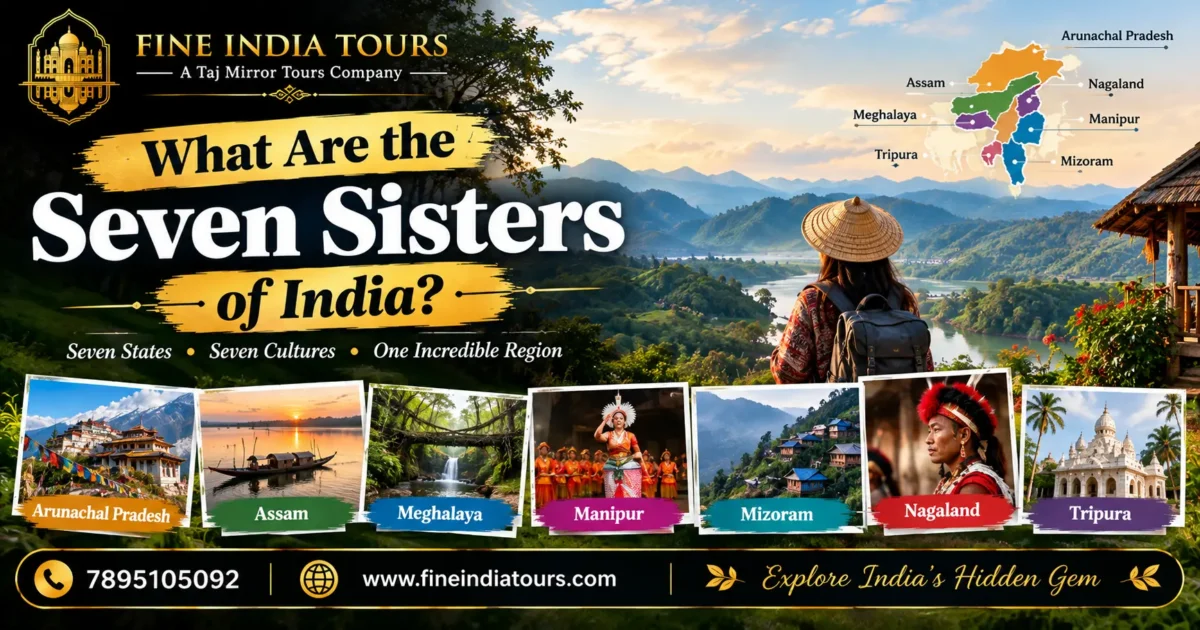
India is known for its incredible diversity, and few regions demonstrate this better than the Northeast. From snow-covered mountains and green valleys to waterfalls, forests, indigenous cultures and historic towns, the region offers a travel experience that feels very different from many popular Indian destinations.
But what exactly are the Seven Sisters of India?
The Seven Sisters of India is a popular term used for seven northeastern states: Arunachal Pradesh, Assam, Manipur, Meghalaya, Mizoram, Nagaland and Tripura. Together, these states form an important part of Northeast India and are known for their distinctive landscapes, cultures, traditions and communities.
The name can sometimes cause confusion because Sikkim is also part of India’s Northeast. However, Sikkim is not one of the original seven states referred to as the Seven Sisters. It became the eighth state of the broader Northeast Region later.
For travellers, understanding this distinction is useful because each state offers a completely different experience.
What Does “Seven Sisters of India” Mean?
The phrase Seven Sisters of India refers to seven neighbouring northeastern states that are geographically connected to one another and share several historical, cultural and geographical links.
These states are:
- Arunachal Pradesh
- Assam
- Manipur
- Meghalaya
- Mizoram
- Nagaland
- Tripura
The region is bordered by several countries, including Bhutan, China, Myanmar and Bangladesh. This geographical position has contributed to the region’s unique cultural and historical character.
However, the Seven Sisters should not be viewed as one identical destination.
Each state has its own languages, communities, traditions, food, festivals and landscapes. Therefore, a journey through Northeast India can include mountains, wildlife, monasteries, waterfalls, caves, tea gardens, tribal heritage and vibrant local markets within the same broader region.
Why Are They Called the Seven Sisters?
The expression “Seven Sisters” became popular as a way of describing the close relationship among the seven northeastern states.
The name is particularly memorable because the states are connected geographically while also maintaining their own distinct identities.
Think of them as seven different destinations within one larger travel region.
For visitors, this is one of the most interesting aspects of the Northeast. A trip from Assam towards Meghalaya can feel very different from travelling towards Arunachal Pradesh. Likewise, Nagaland and Mizoram have their own cultural landscapes and travel experiences.
So, while the Seven Sisters of India are grouped under one popular name, they should be explored as individual destinations.
The Seven Sisters of India at a Glance
| State | Known For | Travel Highlights |
| Arunachal Pradesh | Mountains, monasteries and valleys | Tawang, Ziro, Bomdila, Dirang |
| Assam | Tea, wildlife and the Brahmaputra | Kaziranga, Guwahati, Majuli |
| Manipur | Culture, lakes and heritage | Imphal, Loktak Lake, Keibul Lamjao |
| Meghalaya | Waterfalls, caves and green landscapes | Shillong, Sohra, Dawki |
| Mizoram | Hills, forests and local culture | Aizawl, Champhai, Reiek |
| Nagaland | Tribal heritage and festivals | Kohima, Dzukou Valley, Mokokchung |
| Tripura | Palaces, temples and heritage | Agartala, Ujjayanta Palace, Neermahal |
The table provides only a starting point. Each destination deserves more time if you want to understand its culture rather than simply check places off a sightseeing list.
1. Arunachal Pradesh – The Mountainous Sister
Arunachal Pradesh is the largest of the seven states and is particularly known for its spectacular Himalayan landscapes.
The state is ideal for travellers who enjoy mountains, monasteries, road journeys and quieter destinations.
Tawang is one of its best-known attractions. The area combines dramatic mountain scenery with important Buddhist heritage.
Other places worth considering include:
- Tawang
- Dirang
- Bomdila
- Ziro
- Itanagar
- Mechuka
The state’s landscapes change dramatically as you travel. High-altitude mountains, forests, valleys and rivers create an impressive road-trip environment.
For travellers interested in photography and nature, Arunachal Pradesh can be particularly rewarding.
2. Assam – The Gateway to Northeast India
Assam is often an important starting point for exploring Northeast India.
Its location and transport connections make it a practical entry point for several itineraries. Guwahati, in particular, is an important travel hub.
However, Assam is much more than a gateway.
The state is famous for its tea gardens, the Brahmaputra River and wildlife destinations.
Kaziranga National Park is one of the major attractions. Visitors can also explore Majuli, one of the region’s culturally significant river islands.
Popular experiences include:
- Wildlife safaris
- Tea garden visits
- River experiences
- Cultural sightseeing
- Temple visits
- Exploring Guwahati
Because Assam connects naturally with several neighbouring states, it can also be incorporated into a longer Northeast India itinerary.
3. Manipur – Culture, Lakes and Heritage
Manipur offers a fascinating combination of natural scenery and cultural heritage.
Imphal is the state’s major urban centre and an important base for exploring the surrounding attractions.
One of the best-known natural landmarks is Loktak Lake. The lake is famous for its floating vegetation formations, locally known as phumdis.
Manipur is also associated with the unique Keibul Lamjao National Park, which is located within the Loktak Lake ecosystem.
Travellers can explore:
- Imphal
- Loktak Lake
- Keibul Lamjao National Park
- Kangla Fort
- Local markets
- Traditional cultural experiences
For visitors who want to experience a destination beyond conventional sightseeing, Manipur can offer a deeper cultural perspective.
4. Meghalaya – Waterfalls, Caves and Living Landscapes
Meghalaya is one of the most popular destinations in the Northeast for nature-focused travellers.
Its name is often associated with clouds, and the state’s lush hills, waterfalls and caves make it especially attractive for photographers and outdoor enthusiasts.
Shillong is the state capital and a common base for exploration.
Sohra, also known as Cherrapunji, is another major attraction. The area is known for waterfalls, caves and dramatic landscapes.
Popular places include:
- Shillong
- Sohra
- Nohkalikai Falls
- Seven Sisters Falls
- Mawsmai Cave
- Dawki
- Mawlynnong
The official Incredible India tourism platform also features a Northeast itinerary covering Shillong, Sohra, Seven Sisters Falls, Nohkalikai Falls, Mawsmai Cave, Mawlynnong and Dawki.
This makes Meghalaya a strong choice for travellers who want a combination of scenery, short walks, viewpoints and cultural experiences.
5. Mizoram – Hills, Peaceful Landscapes and Local Life
Mizoram is another fascinating member of the Seven Sisters of India.
The state is characterised by rolling hills, forested landscapes and distinctive local traditions.
Aizawl, the capital, is generally the starting point for visitors.
Beyond the city, destinations such as Reiek and Champhai provide opportunities to experience the state’s natural beauty.
A trip to Mizoram can include:
- Aizawl sightseeing
- Hill viewpoints
- Local markets
- Village experiences
- Scenic road journeys
- Cultural exploration
Mizoram is particularly interesting for travellers who prefer less conventional routes and want to spend time observing local life.
Rather than rushing between attractions, consider allowing enough time to enjoy the scenery and atmosphere.
6. Nagaland – Tribal Heritage and Mountain Culture
Nagaland is well known for its diverse tribal communities and strong cultural traditions.
Kohima is the state capital and one of the main bases for travellers.
The Hornbill Festival has also helped introduce Nagaland’s cultural heritage to a wider travel audience. However, the state offers experiences beyond festivals.
Dzukou Valley is another important attraction for outdoor travellers.
Depending on your itinerary, you can explore:
- Kohima
- Dzukou Valley
- Mokokchung
- Local villages
- Cultural sites
- Traditional markets
Nagaland is especially appealing to travellers interested in culture, photography and mountain landscapes.
As with several northeastern destinations, responsible tourism is important. Visitors should respect local customs, communities and photography preferences.
7. Tripura – Palaces, Temples and Heritage
Tripura completes the traditional list of the Seven Sisters of India.
Located in the southern part of Northeast India, Tripura has a different visual character from the Himalayan states.
Agartala is the capital and a convenient starting point.
The state is known for its heritage sites, palaces, temples and cultural traditions.
Notable places include:
- Agartala
- Ujjayanta Palace
- Neermahal Palace
- Unakoti
- Tripura Sundari Temple
Tripura is an excellent option for travellers interested in history and architecture as well as Northeast Indian culture.
Its heritage attractions also provide a different perspective on the region.
Seven Sisters vs Northeast India: Are They the Same?
Not exactly.
This is one of the most common questions travellers have.
The Seven Sisters of India refers specifically to seven states:
- Arunachal Pradesh
- Assam
- Manipur
- Meghalaya
- Mizoram
- Nagaland
- Tripura
Northeast India is a broader geographical and administrative concept that also includes Sikkim.
Therefore:
Seven Sisters = 7 states
Northeast India = 8 states, including Sikkim
The Government of India tourism material identifies the Northeast Region as comprising eight states, while historical government documentation describes the original seven states as the “Seven Sisters” and notes Sikkim’s later inclusion as the eighth state.
This distinction is important when planning a multi-state itinerary.
What Makes the Seven Sisters Special for Travellers?
The appeal of the region comes from its variety.
Instead of seeing the Northeast as a single destination, think of it as a collection of very different travel experiences.
You can find:
- Himalayan landscapes
- Tea plantations
- Wildlife reserves
- Waterfalls
- Limestone caves
- River islands
- Buddhist monasteries
- Tribal and indigenous cultures
- Historic palaces
- Traditional markets
- Adventure activities
- Scenic road journeys
The region is also particularly valuable for travellers who want cultural experiences alongside sightseeing.
A good itinerary does not simply move from one attraction to another. It leaves room for local food, conversations, landscapes and community experiences.
Best Time to Visit the Seven Sisters
There is no single perfect month for the entire Northeast because weather conditions vary significantly between states and altitudes.
However, many travellers consider the cooler and comparatively drier months useful for exploring several parts of the region.
Your ideal travel period should depend on your chosen route.
For example:
- Winter: Suitable for many sightseeing and road-trip itineraries, although higher areas can be cold.
- Spring: Pleasant for landscapes, flowers and outdoor exploration in several destinations.
- Monsoon: Meghalaya becomes exceptionally lush, but heavy rainfall can affect roads and sightseeing plans.
- Autumn: Often attractive for clear landscapes and cultural travel.
Before booking, check the latest local weather and road conditions, particularly for mountain routes.
How to Plan a Seven Sisters Tour
Planning the entire Seven Sisters of India in one trip can be ambitious.
The states cover a large geographical area, and travel times can be longer than they appear on a map.
A practical approach is to select destinations based on your interests.
For nature lovers
Consider combining:
- Meghalaya
- Assam
- Arunachal Pradesh
For culture-focused travellers
Consider:
- Nagaland
- Manipur
- Mizoram
- Tripura
For a first Northeast experience
A route involving Assam and Meghalaya can provide a relatively broad introduction to the region.
For longer journeys, adding Arunachal Pradesh can bring mountains and monastery experiences into the itinerary.
The most important point is to avoid trying to see everything too quickly.
A slower itinerary often creates a much better travel experience.
Why Choose Fine India Tours for Your Northeast Journey?
Travelling across the Northeast requires more than simply booking hotels and transportation.
Routes can involve long drives, changing terrain, different local conditions and destination-specific planning.
Fine India Tours focuses on personalised India travel experiences and tailor-made itineraries rather than treating every traveller’s journey in the same way.
The company can help travellers plan an itinerary based on:
- Trip duration
- Preferred destinations
- Accommodation preferences
- Private transportation
- Sightseeing interests
- Cultural experiences
- Family or group requirements
- Budget considerations
For a multi-state journey, itinerary planning can make a significant difference.
Instead of attempting to fit all seven states into one rushed schedule, Fine India Tours can help structure the journey around the places and experiences that matter most to you.
This approach is especially useful for international travellers visiting Northeast India for the first time.
What Should You Know Before Visiting?
The Northeast rewards preparation.
Before travelling, consider:
- Checking entry and permit requirements for your chosen destinations.
- Confirming road conditions before travelling to remote areas.
- Keeping flexible travel time for mountain routes.
- Carrying appropriate clothing for changing weather.
- Respecting local customs and traditions.
- Asking before photographing people or ceremonies.
- Choosing responsible local tourism experiences.
- Keeping some flexibility in your itinerary.
Requirements can change, so travellers should always verify the latest rules with relevant government authorities before departure.
Final Thoughts
The Seven Sisters of India represent one of the most culturally and geographically diverse parts of the country.
From Arunachal Pradesh’s Himalayan mountains to Assam’s wildlife and tea landscapes, Meghalaya’s waterfalls, Manipur’s lakes, Mizoram’s hills, Nagaland’s cultural heritage and Tripura’s historic attractions, every state offers something different.
That diversity is exactly what makes Northeast India so fascinating.
Rather than trying to see everything in a hurry, choose the experiences that match your interests and allow enough time to appreciate each destination.
If you are planning your first Northeast India journey, a well-designed private itinerary can make the experience more comfortable and meaningful. Fine India Tours can help you create a personalised route that combines sightseeing, local experiences, comfortable transportation and carefully planned stays.
The Northeast is not simply a collection of seven states. It is a region of mountains, communities, stories, traditions and landscapes that deserve to be explored with time and respect.
Frequently Asked Questions About the Seven Sisters of India
Q.1 What are the Seven Sisters of India?
The Seven Sisters of India are Arunachal Pradesh, Assam, Manipur, Meghalaya, Mizoram, Nagaland and Tripura. These seven states form a major part of India’s Northeast and are known for diverse landscapes, cultures, communities and travel experiences.
Q.2 Is Sikkim one of the Seven Sisters?
No. Sikkim is not one of the original Seven Sisters. It is part of the broader Northeast Region, which consists of eight states. The seven traditional states are Arunachal Pradesh, Assam, Manipur, Meghalaya, Mizoram, Nagaland and Tripura.
Q.3 Which is the best state among the Seven Sisters to visit?
There is no single answer because each state offers a different travel experience. Meghalaya is known for waterfalls and caves, Assam for wildlife and tea, Arunachal Pradesh for Himalayan scenery and monasteries, Nagaland for cultural heritage, and the other states offer their own distinctive attractions.
Q.4 How many days are needed to explore the Seven Sisters?
Exploring all seven states properly would require a substantial amount of time. For a first trip, it is usually more practical to choose two or three states and create a focused itinerary rather than attempting to cover the entire region in a short holiday.
Q.5 Can I plan a private Seven Sisters tour from India?
Yes. A private itinerary can be designed around your travel dates, preferred destinations, transportation, accommodation and interests. Fine India Tours can help create a customised Northeast India journey based on your requirements.